

Affordable, secure and sustainable energy – preferably all at once. All while markets, regulations, weather conditions, technology and often the company itself are changing. Corporate energy management can hardly be treated as a procurement task alone anymore. To make good decisions, companies first need to understand where they stand, what they actually need, and how much room for manoeuvre they can create for themselves.
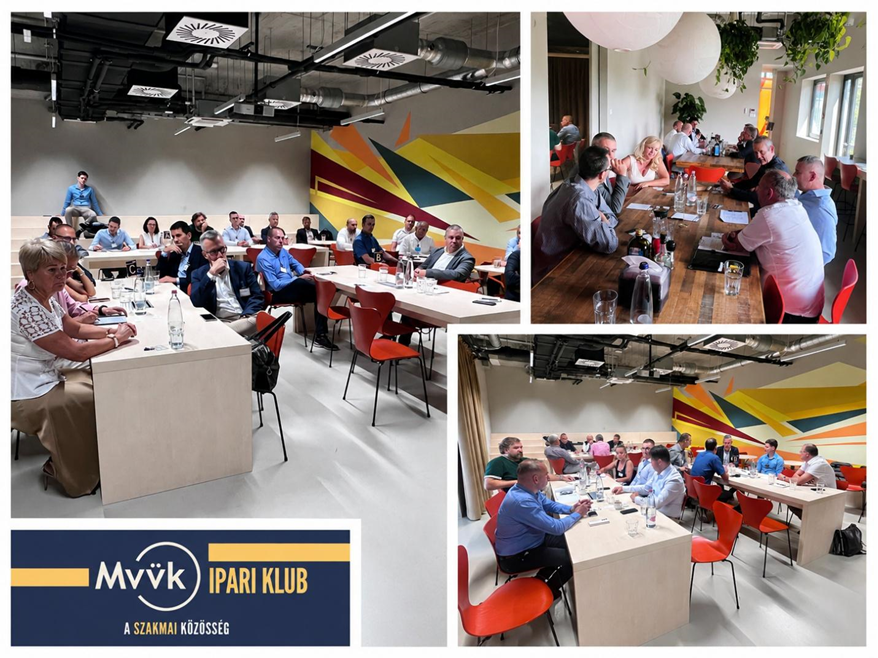
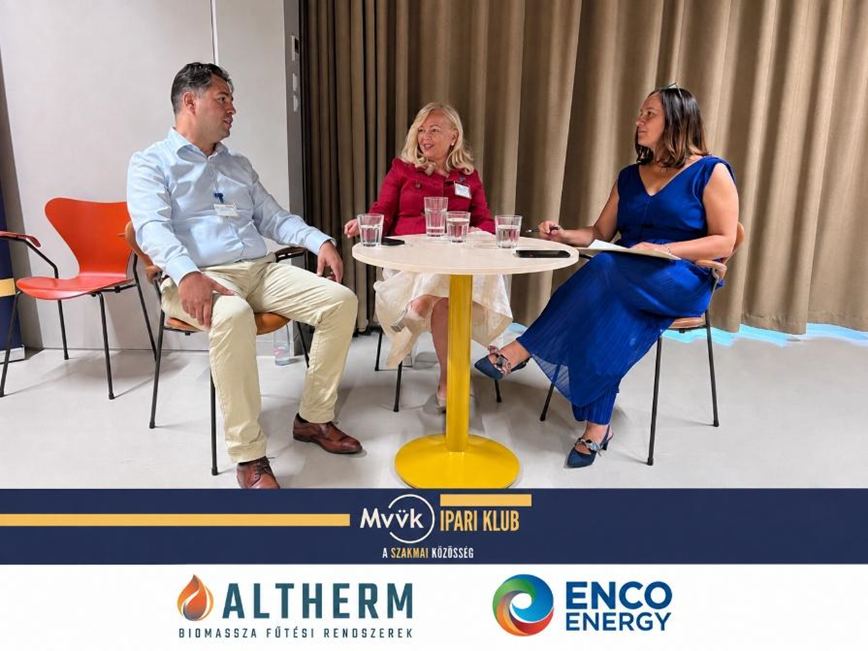
This was the topic of our discussion on 27 August 2026 at the MVÜK Ipari Klub’s (Industrial Club) professional energy day, together with Andrea Sarusi-Molnár, Managing Director of Altherm Kft. and Alternconsult Kft.; Gusztáv Czöndör, Managing Director of ENCO Energy Kft.; and the corporate leaders and expert members of the Ipari Klub (Industrial Club). The discussion was moderated by Mandy Fertetics, Managing Director of Alternate Tanácsadó Kft.
Perhaps the most important takeaway of the day was that there is rarely a single technology, investment or “right” energy source that can address today’s energy challenges. A complex problem requires a tailored solution based on systems thinking.
| WRITER: Fertetics Mandy | READING TIME: 14 minutes
It is not necessarily energy that has become more unpredictable – but the world around it
In recent years, the environment in which companies make decisions about energy has changed significantly.
Unpredictable weather can directly affect production and the availability of renewable energy. Energy prices and supply routes respond to geopolitical events. Regulation, taxation, and the support and financing environment are changing. New technologies are emerging, while infrastructure – such as the electricity grid – cannot always keep pace with them.
At the same time, many dependencies that were previously less visible have become tangible.
According to the European Commission’s 2026 summary, the EU generated 43% of its own energy demand in 2024, while 57% was covered by imports. The Commission also highlights that without improvements in energy efficiency, EU energy consumption today would be approximately 27% higher.
At company level, additional dependencies may arise: on a single energy carrier, technology, supplier, grid, or even a specific production process.
The management question is therefore increasingly less about “How cheaply can I buy energy?”, and increasingly more about: Which exposures do I need to accept, and which ones can I gain greater control over?
“For many companies, the problem is not that they have no energy or sustainability-related risks, but that these risks have not yet become management information. They have not been identified, quantified, or translated into financial exposure and business opportunity. Yet what we do not understand and cannot capture in financial, operational or strategic terms, we tend to underestimate.”
– Mandy Fertetics, Alternate Tanácsadó Kft.
This is a recurring challenge in sustainability and materiality assessments as well: an environmental or social impact or risk does not automatically become a factor in business decision-making. It is also necessary to understand how it manifests itself in costs, operational exposure, financing, customer retention or even new market opportunities.
Energy is a good example from this perspective: it is simultaneously a cost, an operational requirement, a source of emissions, a supply risk and – when the right decisions are made – a competitive advantage.
“We need solar panels.” Are you sure?
One of the most common mistakes happens right at the beginning of the decision-making process.
The company approaches the expert not with a problem, but with a ready-made solution.
“We need biomass.”
“We need solar panels.”
“We need twelve megawatts instead of six.”
However, the decision is not always based on detailed measurement, technical calculations or a clear business vision. Perhaps a competitor chose this solution. Perhaps it is supported by a grant. Perhaps favourable financing is available for it. Or perhaps a supplier recommended it.
Yet the same technology can produce completely different results at two companies of a similar size.
The production profile, shift patterns, daily and seasonal energy demand, geographical characteristics of the site, available local resources, company size, growth plans, technology, financing opportunities – as well as the way different energy solutions interact with one another – all matter.
This is why Gusztáv Czöndör emphasised the importance of thinking in terms of an energy portfolio.
“We should not optimise a single technology, but the company’s entire energy system. A good solution always starts from the company’s operations, plans and actual consumption data. Different developments should not be assessed separately, but together with their impact on one another.”
– Gusztáv Czöndör, ENCO Energy Kft.
This logic is actually very similar to financial portfolio management. The question is not whether a single asset is “good”, but what kind of cost, risk and flexibility profile the entire system creates.
Locally available energy can become a strategic resource
Andrea Sarusi-Molnár approached the same question from another angle: let’s also look at what is already available around us.
For example, an agricultural company may generate by-products whose energy content can be utilised locally. Prunings, crop residues, wood chips, bales or other agricultural by-products may, under certain circumstances, not be waste but an energy source.
Andrea emphasises the connection between biomass, local energy sources and more stable, predictable operations. According to Altherm’s 2026 professional summary, energy efficiency and long-term cost savings are increasingly becoming strategic issues in the agricultural sector, while the unpredictability of fossil fuel prices and growing sustainability expectations are driving businesses towards more stable solutions.
“It is worth looking around first: what energy sources are available locally, what do we already produce, or what is already generated through our operations? If we can produce energy locally from a resource that is available locally and then use it locally, this can provide not only sustainability benefits, but also energy security and economic advantages.”
– Andrea Sarusi-Molnár, Altherm Kft. / Alternconsult Kft.
And this is by no means limited to biomass. The same logic applies to solar energy, biogas, heat pump systems, waste heat recovery, and increasingly to energy and water storage as well.
Three figures that show how much the energy landscape has changed
In 2024, the EU covered 57% of its energy demand through imports. In the same year, solar energy accounted for approximately one quarter of Hungary’s electricity generation. In barely a decade, the share of solar energy in Hungary has grown from a marginal level to one of the defining elements of the electricity mix.
The trend itself is important, but the real management lesson is not that “everyone needs solar panels.” Quite the opposite.
The more weather-dependent energy enters the system, the more important flexibility, storage, demand-side management and the coordination of different energy sources become.
Green energy is no longer a separate world
The question of “green or not green?” increasingly fails to capture the real corporate dilemma.
The better question is: What energy mix can provide the right combination of cost, energy security, flexibility and environmental performance for the company’s vision and circumstances?
The growing role of renewables has both environmental and business implications.
Locally generated energy can reduce external dependencies. Energy efficiency can lower both costs and emissions. Storage can increase flexibility. Better measurement is a prerequisite for all of these.
The paradox of cheap energy
One of the more provocative ideas raised during the event was that cheap energy can even become an obstacle to progress.
Not because lower energy costs are inherently bad. Rather, when energy feels consistently cheap, it becomes easier to live with waste and easier to postpone investments that would make operations more efficient and resilient in the long term.
In companies’ operations, losses almost inevitably arise.
Old and new technologies are layered on top of one another. Capacity is expanded. The product portfolio changes. Shift patterns change. A solution initially intended to be temporary becomes permanent. Due to uncertainty in customer orders, unused capacity inevitably remains.
In such “patchwork” systems, energy consumption can easily become disconnected from what would be technically or economically justified.
Not every loss can be eliminated. But it matters whether we are aware of it and consciously accept it, or simply continue paying for it month after month.
An energy audit is not an exam
If an assessment is so useful, why do many companies still postpone it?
The participants identified several reasons. Managers may fear that an audit will highlight errors or shortcomings that will be uncomfortable to confront: “If they realise I made a mistake, there may be consequences.” There may also be a lack of trust towards the service provider: “They are probably investigating because they want to sell me something afterwards.”
And there is another important human factor: resistance to change.
A good assessment will almost inevitably identify opportunities for change. Implementing them requires decisions, management attention, time, investment and organisational energy.
This is particularly difficult when companies are already under pressure and, due to an uncertain environment, are planning over increasingly shorter time horizons.
Yet, according to Gusztáv Czöndör, the purpose of an audit is not simply to look for mistakes.
“A good audit very often reveals something to management that they did not know before, misunderstood, or had only suspected. And equally importantly, the expected impact of improvements can be modelled in advance. This means that we are not investing in the promise of a technology, but making decisions based on numbers.”
– Gusztáv Czöndör
According to the practical experience shared during the discussion, audits frequently lead to new insights of this kind, and the savings opportunities identified can amount to several times the cost of the assessment. Both energy experts emphasised that in their own practice, the cost of a meaningful assessment has been recovered through the opportunities identified.
This distinction is important because an audit is therefore not merely a compliance cost, but a basis for investment decisions and management decision-making.
One of the most important things a manager can say: “I don’t know enough about this”
Perhaps this is the most difficult realisation.
An experienced company leader – or even a technical manager – may know their own business extremely well, while it cannot reasonably be expected that they follow the development of energy technologies, the electricity market, energy procurement structures, tax and accounting opportunities, the Hungarian Energy Efficiency Obligation Scheme (EKR), different financing models and changing energy regulations with the same level of depth.
An external energy expert, however, has another limitation: they do not know the company as well as its own management does.
They cannot know on their own that a new product will be launched in two years. That a production line will be shut down. That the company will switch export markets. That a new shift will be introduced. That the current site will soon become too small.
Therefore, the right question is not “external expert or internal knowledge?”
The right solution is the combination of the two.
The external party brings professional distance, benchmarks and energy expertise. The company brings the business context, its vision for the future and operational reality.
The participants also spoke about the challenges and necessity of continuous learning and self-development – for example, when an energy auditor must also become a company’s “tax and financial adviser”, or when an investment contractor needs to act as a “change manager”.
For this reason, it may be increasingly difficult to think simply in terms of bringing in an individual expert. Instead, it may be more valuable to involve an expert company or team with the breadth of knowledge required.
Energy does not stop at the factory gate
A company’s energy exposure is no longer limited to the energy consumption of its own sites. It also appears in suppliers’ carbon intensity, logistics, the embedded emissions of purchased raw materials, and increasingly in customer, financier and regulatory expectations.
Identifying value-chain emissions is therefore not merely a matter of carbon accounting. It can also reveal where significant energy and supplier dependencies exist within the business.
Carbon pricing, carbon-related costs associated with certain products, and customer decarbonisation requirements are creating an increasingly direct link between emissions and financial performance.
“The strategic importance of energy does not stop at the boundaries of a company’s site. It is reflected in the product carbon footprint, supplier performance, procurement decisions and increasingly in customer, financier and regulatory expectations. This is why energy efficiency and decarbonisation will sooner or later also become questions of responsible supply chains and procurement strategy.”
– Mandy Fertetics
This is particularly important for companies that are not yet directly subject to strict reporting or decarbonisation requirements. The requirement often does not come directly from legislation, but from the customer.
This is where sustainability reporting can become genuinely useful
Sustainability reporting – whether voluntary or mandatory – can therefore create business and management value beyond communication.
A properly conducted process is effectively an organisational assessment.
It is not only necessary to determine how much energy a company consumes or how large its emissions are, but also:
- where the most significant impacts occur,
- what risks are associated with them,
- which of these may be financially material,
- what targets and measures are in place,
- who is responsible for them,
- and whether the company has adequate data to support decision-making in the first place.
In this sense, the logic of an energy audit and a sustainability assessment comes very close together. Both make visible something that we previously understood only partially.
The technology is already here
The discussion among the members of the MVÜK Industrial Club also demonstrated that companies can choose from a much broader range of solutions than what we initially associate with an “energy investment”.
Alongside local energy generation, the discussion covered energy audits and energy procurement, the tax and “green tax” aspects of energy-efficiency investments, the Hungarian Energy Efficiency Obligation Scheme (EKR), drone-assisted preparation and inspection of investments and assets, modernisation of industrial cooling and heating systems and the use of natural refrigerants, water and energy storage, as well as digital measurement and control.
This is an important message for both SMEs and large companies.
Not every energy improvement requires a hundreds-of-millions-of-forints power plant investment. The next good decision might be a sub-meter. An invoice analysis. A control-system adjustment. A change in contracted capacity. A heat recovery solution. A different energy procurement structure. Or, indeed, recognising that something completely different is needed instead of the major investment originally planned.
What can a manager do on Monday morning?
They do not necessarily need to start by choosing an energy technology.
Three types of information are worth putting side by side: financial data, technical data and physical reality.
Do the bills and meters tell the same story? Are accounting data consistent with technical consumption? If not, where is the discrepancy? What do we see at the machines? What is operating even when it should not be? Where is unnecessary heat, cooling, pressure or movement being generated? Which of our assumptions have we not verified for years?
The second step is the future vision.
Where does the company want to operate two, three or five years from now? What will it produce? At what capacity? For which markets? Under what customer and sustainability expectations?
Only then does the energy question follow: What infrastructure, energy mix and development pathway will be required to support this?
Perhaps this is the most important shift in mindset.
The goal is not to find “the best energy” today. Such a thing probably does not exist.
Instead, companies need to develop an energy system that can evolve together with the company and its environment; one with less waste and fewer poorly understood exposures, and more consciously chosen alternatives and local control.
Sustainability becomes a genuine business issue when environmental impact, dependency and risk are addressed within the same decision-making space as cost, investment and growth.
Ultimately, energy resilience is not an energy source – it is a management capability.
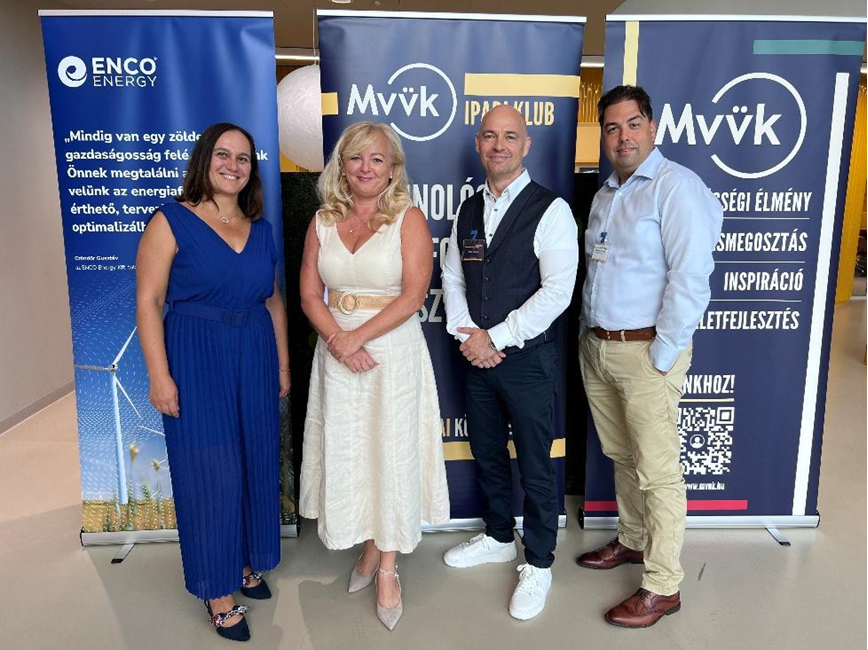
Az írás az MVÜK Ipari Klub 2026. augusztus 27-i energetikai szakmai napján (a képen látható sorrendben): Fertetics Mandy (Alternate Tanácsadó Kft.), Sarusi-Molnár Andrea (Altherm Kft., Alternconsult Kft.), Tóth Gábor (MVÜK Ipari Klub vezető), Czöndör Gusztáv (ENCO Energy Kft.), és az MVÜK Ipari Klub résztvevői között zajló szakmai beszélgetés gondolataira és tapasztalataira, valamint nyilvánosan elérhető szakmai és statisztikai forrásokra épül.
This article is based on the ideas and experiences shared during the professional energy day of the MVÜK Ipari Klub (Industrial Club) on 27 August 2026 (in the order shown in the photograph): Mandy Fertetics (Alternate Tanácsadó Kft.), Andrea Sarusi-Molnár (Altherm Kft., Alternconsult Kft.), Gábor Tóth (Head of the MVÜK Ipari Klub (Industrial Club)), Gusztáv Czöndör (ENCO Energy Kft.), and the participants of the MVÜK Ipari Klub (Industrial Club), as well as publicly available professional and statistical sources.