

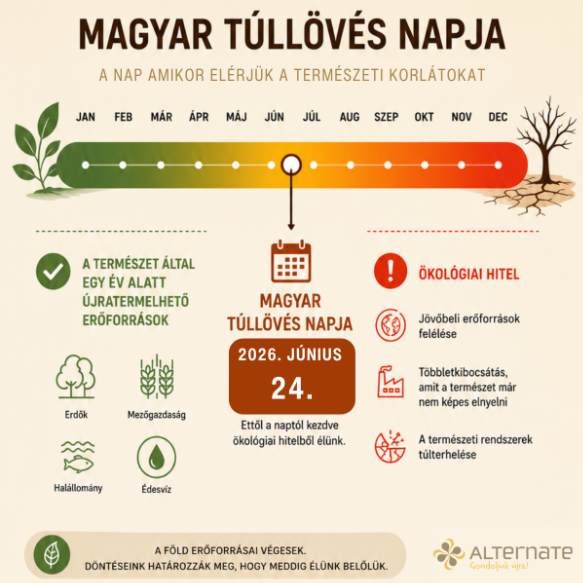
We “celebrate” Hungary’s Overshoot Day: what does it actually mean, and what are the implications for businesses? June 24… In 2026, Hungary’s Overshoot Day once again reminds us that the country uses up the natural resources available for the entire year well before the end of the year. From this day onwards, we are living in ecological “debt”: we consume resources that nature can no longer regenerate within a single year, and we generate more waste and emissions than ecosystems are able to absorb.
Overshoot Day is an annual awareness milestone. Although it does not represent an exact scientific threshold, it effectively illustrates the extent to which our economic performance and consumption patterns rely on the depletion of natural capital.
| WRITER: Papp Viktória
What is Overshoot Day?
The indicator is calculated using the ecological footprint methodology, which is widely applied in international sustainability research. The concept is simple:
- the ecological footprint of a given country or the entire world is compared;
- with the available biological capacity (biocapacity);
- and the date is determined when the annual resource budget is exhausted.
The earlier Overshoot Day occurs, the greater a country’s resource consumption is compared to its available natural capacity. Unfortunately, this date is arriving earlier and earlier each year. While it occurred in December in the early 1970s, in 2026 global Overshoot Day will already take place on 30 July.
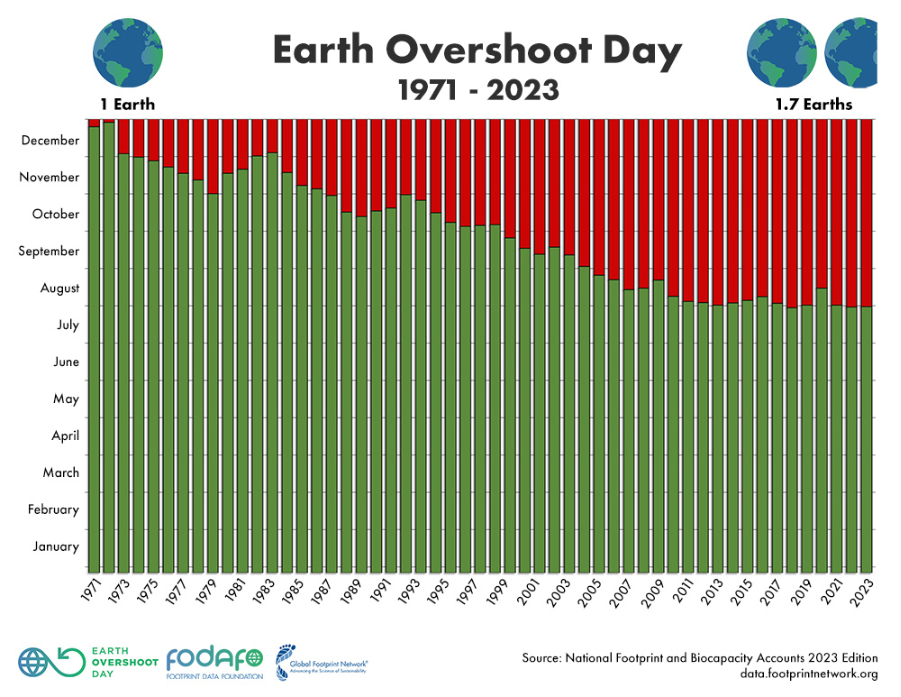
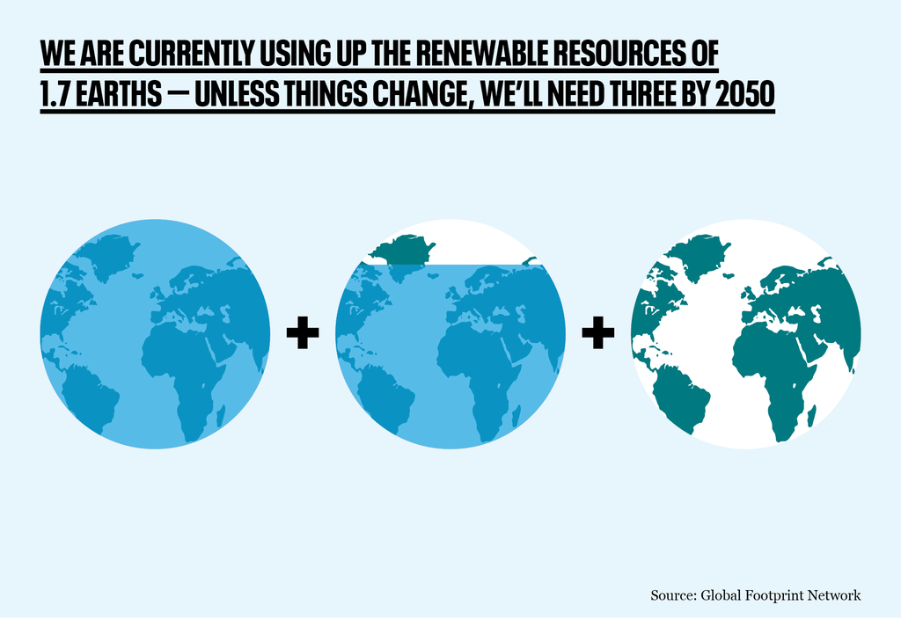
Globally, humanity currently uses approximately 1.7 Earths’ worth of resources every year. This means that, collectively, we are consuming natural capital faster than it can regenerate. If this trend continues, by 2050 we would need three Earths.
Why do countries differ?
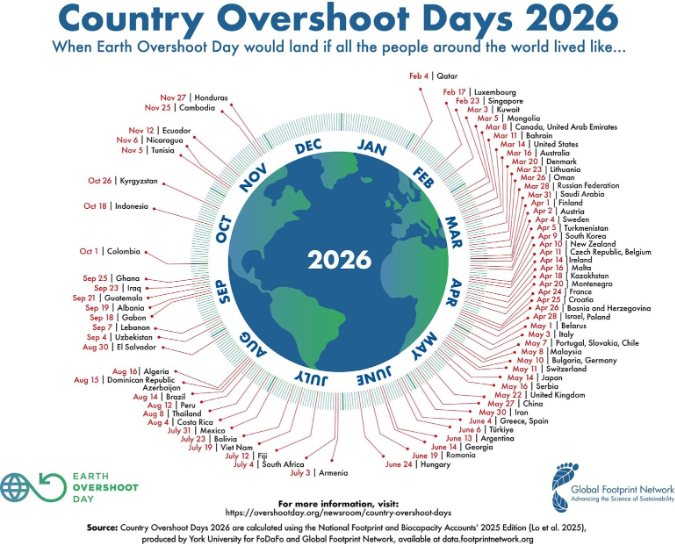
Overshoot Day varies significantly between countries. Some high-income countries reach this point within the first months of the year, while others only reach it towards the end of the year — or not at all.
There are several reasons for these differences:
1. Consumption levels
Higher-income societies generally use more energy, raw materials, and products. Housing, transport, food consumption, and services together create a larger ecological footprint.
2. Energy consumption
It matters greatly how much an economy relies on fossil fuels. Energy use and the associated carbon dioxide emissions represent one of the largest components of the ecological footprint.
3. Natural conditions
Countries also differ in their biocapacity. A country with extensive forest areas, fertile agricultural land, or low population density may be in a more favourable position than a densely populated economy dependent on resource imports.
4. Economic structure
Industrial production, infrastructure development, and export-oriented manufacturing also significantly influence resource consumption.
Global, European, and Hungarian perspectives
Europe is one of the world’s largest consumers of materials and energy. Although several environmental indicators have improved over recent decades, and many countries have reduced the energy or material intensity required to produce one unit of GDP, absolute consumption levels remain high.
This year, the European Union used up its annual share of natural resources by 3 May.
Hungary’s situation reflects many of the challenges faced by Central European economies. Despite improvements in energy efficiency, technological progress, and increasingly stringent environmental regulations, material consumption and consumption patterns continue to create significant environmental pressures.
This raises a fundamental question: is technological progress alone sufficient?
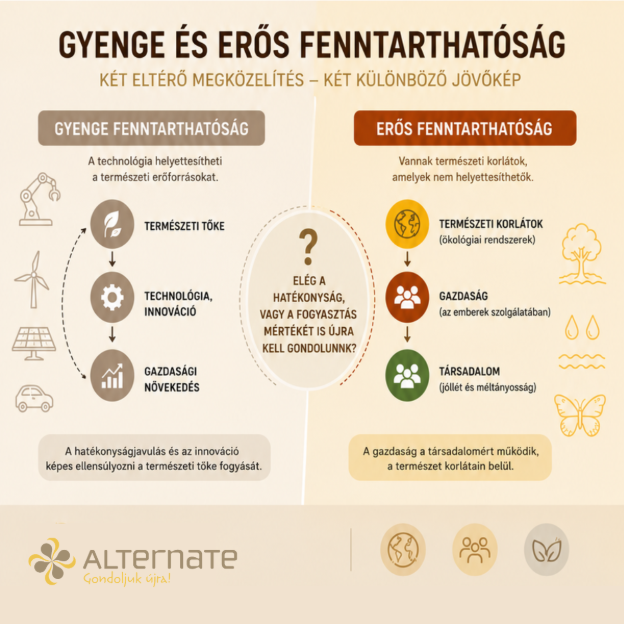
Weak and strong sustainability: two different approaches
One of the central debates in sustainability theory concerns the extent to which natural capital can be replaced by technological or economic capital.
The weak sustainability approach
Weak sustainability assumes that technological development and innovation can compensate for the depletion of natural resources. A key concept within this approach is decoupling, meaning the separation of economic growth from environmental impact.
There are indeed many positive examples:
- increasingly energy-efficient technologies;
- lower-emission production processes;
- the expansion of renewable energy sources;
- digitalisation and automation.
However, the key question is whether efficiency improvements are sufficient to reduce absolute resource consumption. International research indicates that this has often not occurred to a degree compatible with the planet’s ecological limits.
The strong sustainability approach
Strong sustainability starts from the assumption that certain natural systems and ecosystem services cannot be replaced by technology. Biodiversity, fertile soil, freshwater resources, and a stable climate are fundamental conditions for economic activity, and their loss cannot simply be compensated for through economic mechanisms.
From this perspective, sustainability is not solely a question of efficiency, but also of recognising and respecting natural limits.
Moderation as a business and societal virtue
For this reason, Overshoot Day highlights not only a technological challenge. Sustainability is increasingly becoming a question of moderation.
Long-term economic success does not necessarily come from continuously increasing material and energy consumption. More and more companies are recognising that value creation and resource use do not have to increase proportionally.
The competitive business models of the future are likely to be those capable of creating the same — or greater — customer value with fewer materials, less energy, and longer-lasting solutions.
The circular economy does not start with waste
The circular economy is often associated with waste management, but the true objective is not better waste treatment — it is waste prevention.
The key questions are:
- How can we use fewer raw materials?
- How can product lifetimes be extended?
- How can services replace product ownership?
There are already numerous successful examples internationally.
The lighting company Signify, in several of its projects, does not sell lighting equipment but provides lighting services through a “light as a service” model. Customers purchase lighting rather than owning the physical equipment. This encourages the manufacturer to develop longer-lasting, repairable, and more energy-efficient systems.
A similar logic applies to the carpet-as-a-service model developed by Interface, where customers do not necessarily own the carpet but pay for its use. This creates incentives for the manufacturer to extend product lifetimes, promote reuse, and maintain material circulation.
These models demonstrate that the essence of the circular economy is not recycling waste, but reducing material demand and rethinking how value is created.
What does Hungary’s Overshoot Day tell us?
Overshoot Day is not about a single date. It is a symbol of how we can align our economic systems with the functioning of natural systems.
Technological progress remains essential, but it is unlikely to be sufficient on its own. Alongside efficiency, moderation, conscious resource use, and business models capable of creating greater value from fewer materials will become increasingly important.
According to Mandy Fertetics, Managing Director and Founder of Alternate:
“Alternate represents the strong sustainability perspective in its advisory and educational work, and we hope to increasingly work with leaders, professionals, and organisations that are willing and able to explore transformation opportunities based on this approach.
This can sometimes feel frightening, as scarcity and limitations may appear to be burdens — especially when growth is still understood primarily in quantitative terms. However, if we reframe our perspective and begin to see the systems around us as sources of security, support, harmony, and connection, we may recognise that we can contribute to these systems and create something new.
Let us create together, learning from the greatest artist of all: nature.”
Hungary’s Overshoot Day is therefore not merely an environmental warning, but also an economic and business message: long-term competitiveness and sustainability are increasingly becoming two sides of the same coin.
If you are interested in further details about Overshoot Day, you can read more here: https://overshoot.footprintnetwork.org/newsroom/country-overshoot-days/
More detailed information about changes over the years is available here: https://data.footprintnetwork.org/#