

In recent years, the Science Based Targets initiative (SBTi) has become one of the most influential players in the field of corporate climate commitments. More than 13,000 companies worldwide have already joined the initiative, making science-based emissions reduction targets a de facto industry standard.
| WRITER: Viktoria Papp
SBTi has now announced the beginning of a new era with the launch of its 2026–2030 strategy, introducing a significant shift in corporate sustainability thinking. The message is clear: the focus is no longer solely on setting targets, but on actual implementation and measurable outcomes.
The full strategy is available on the official SBTi website: SBTi 2026–2030 Strategy
SBTi’s role in corporate target-setting was never merely formal or simply a sign of good business judgment. Traditionally, greenhouse gas (GHG) emissions targets, energy consumption targets, and related reduction objectives were often planned on an annual basis: companies would set a realistically achievable target compared to the previous year’s performance, based on historical data and aligned with future business plans. SBTi was the organization that emphasized and operationalized the principle that emissions reduction targets should not be benchmarked solely against historical performance. Instead, targets must be equitable, taking into account the organization’s sector, activities, size, and geographical context. There is a “scientific” methodology that defines what level of contribution an organization should reasonably undertake in relation to shared global climate goals and burdens. This represented a major paradigm shift in corporate thinking – recalls Mandy Fertetics, Managing Director of Alternate.
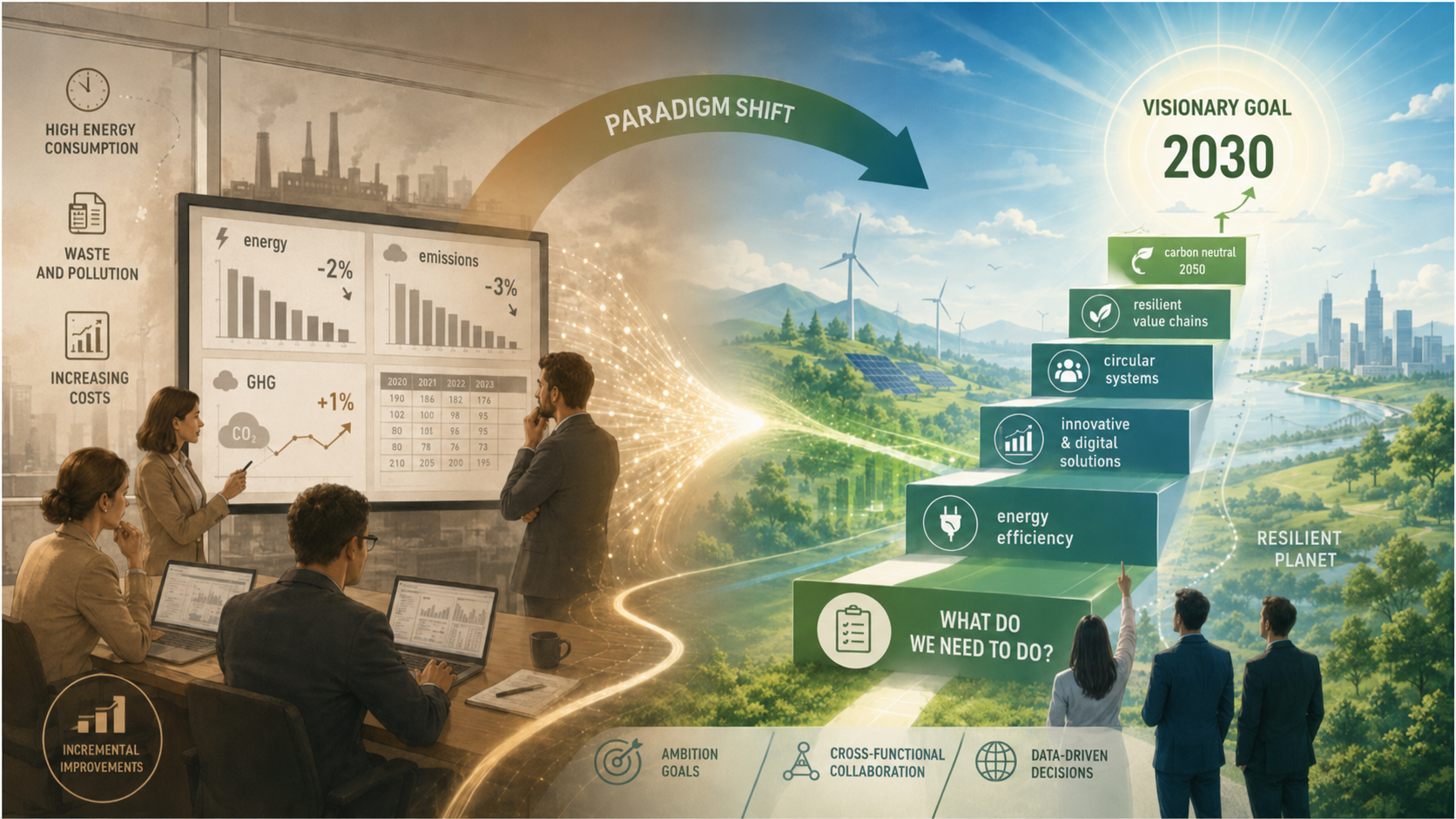
SBTi’s New Role: From Target Setter to “Transformation Partner”
Over the past decade, the key question for most companies was: What net-zero or emissions reduction target should we commit to?
In the coming years, however, the emphasis will shift toward:
- how these targets can actually be achieved,
- how genuine progress can be measured,
- and how climate strategy can become a business competitive advantage.
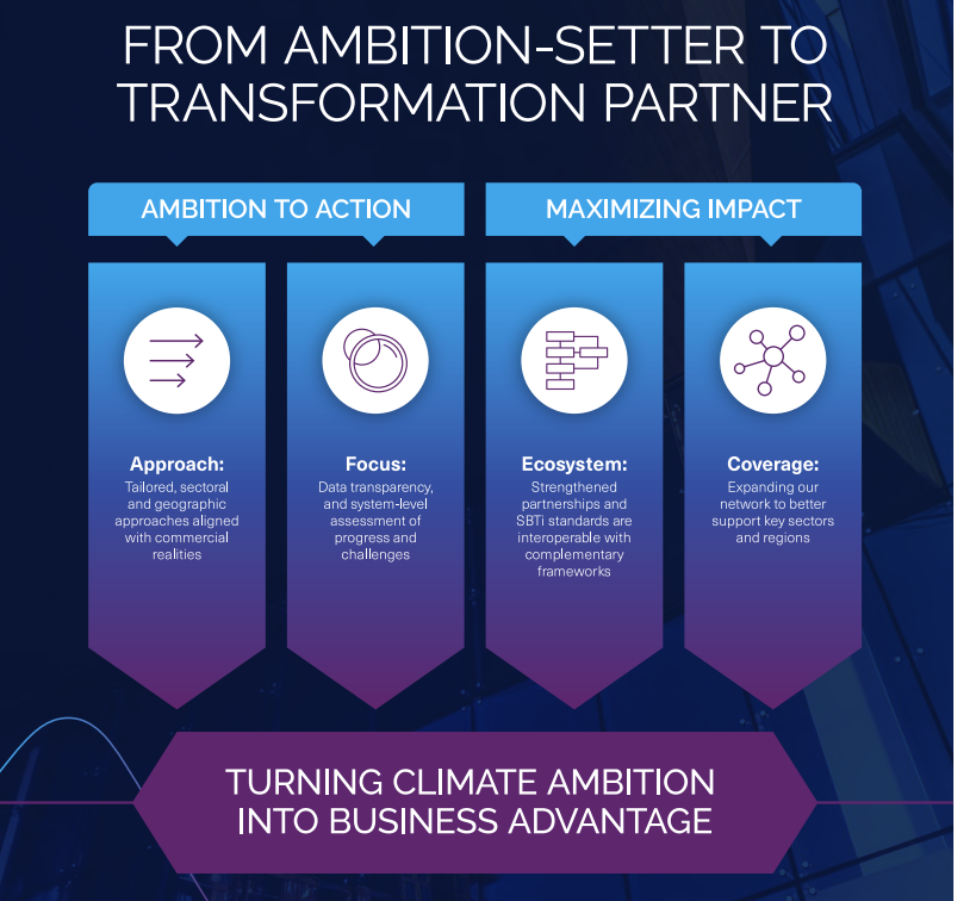
Accordingly, SBTi is redefining its own role – evolving from an “ambition setter” into a “transformation partner.” This means that implementation support tools, benchmarks, data solutions, and sector-specific guidance will receive much greater emphasis in the future.
Four Major Strategic Changes
1. From Generic Targets to Sector- and Region-Specific Approaches
One of the most important changes is SBTi’s move away from generalized emissions reduction models toward far more sector-specific methodologies. A technology company, a steel manufacturer, and a logistics provider all face fundamentally different decarbonization challenges.
The same applies geographically: the operational environment of a European company may differ substantially from that of businesses operating in African or Asian markets. The new strategy therefore promises greater flexibility and more relevant guidance.
This is particularly critical for hard-to-abate sectors such as:
- steel production,
- cement manufacturing,
- shipping,
- and aviation.
2. Greater Emphasis on Implementation and Transparency
SBTi has recognized that making commitments alone is no longer sufficient. Investors, regulators, and customers increasingly expect companies to:
- provide credible data,
- transparently demonstrate progress,
- and achieve verifiable emissions reductions.
This direction strongly aligns with evolving European regulatory frameworks, including the systems and requirements of the Global Reporting Initiative (GRI), CDP, the IFRS Foundation, the International Organization for Standardization (ISO), and the Corporate Sustainability Reporting Directive (CSRD).
The overarching objective is to improve interoperability – enabling different reporting systems and standards to work together more effectively while reducing the administrative burden on companies.
What Does This Mean for SMEs?
These changes affect not only large corporations. In fact, they may be even more significant for small and medium-sized enterprises (SMEs).
According to SBTi’s strategy, the coming years are expected to bring:
- simplified target-setting processes,
- more scalable solutions tailored for smaller companies,
- and increased implementation support.
One particularly important trend for SMEs is that large corporations are increasingly integrating suppliers into their own climate target achievement efforts. This means SMEs may encounter SBTi-related requirements even if they are not directly participating in the initiative themselves.
The Most Important Challenges Facing SMEs
1. Data Collection and Reporting
Many smaller companies still lack adequate carbon footprint measurement capabilities or ESG data management systems – or at least not in a format that can effectively support B2B communication.
At the same time, the new SBTi strategy clearly moves toward greater measurability, while large corporations and customers will increasingly require more detailed and more specific supplier data to support their decarbonization strategies.
2. Supplier Pressure
Multinational companies are expected to request increasingly detailed emissions data from their suppliers. This will particularly impact exporting SMEs and businesses integrated into international supply chains.
Data requests are not only driven by legal compliance or stock exchange reporting obligations on the customer side. Companies also need this information to align product development, process optimization, and supplier selection systems with their decarbonization strategies through data-driven decision-making.
For this reason, organizations require information from their partners not only about results, but also about challenges and obstacles.
3. Financing Advantages
On the positive side, SMEs that adapt early will likely:
- gain easier access to green financing,
- strengthen their market position,
- and achieve competitive advantages among sustainability-conscious customers.
Collaboration Is Becoming Increasingly Important
One of the most interesting elements of SBTi’s new strategy is its effort to reduce fragmentation. In recent years, companies have often struggled to navigate the growing number of ESG frameworks, standards, and reporting expectations.
The new direction aims to ensure that:
- standards become better aligned,
- parallel reporting obligations decrease,
- and compliance becomes simpler.
This is especially important for SMEs, for whom ESG administration can represent a disproportionately large resource burden.
According to our Managing Director, Mandy Fertetics, the pragmatic, practical, yet professionally grounded approach and organizational development capabilities of skilled consultants or internal sustainability professionals are critically important in this context.
One of Alternate’s competitive advantages is our ability to translate international expectations, reporting formulas, and terminology – typically designed for large corporations – into language and implementation approaches that are understandable and achievable for SME owners, managers, and employees. This can become a key success factor in transformation processes.
Expansion Toward Asia and Africa
Another major pillar of the strategy is strengthening SBTi’s presence in Asia and Africa. Global emissions reduction goals cannot be achieved solely through the participation of European and North American companies.
Due to global supply chains, this development may directly affect European businesses as well, since increasing attention will be placed on managing emissions across the entire value chain.
SBTi’s 2026–2030 strategy clearly demonstrates that corporate climate action has entered a new phase. In the future, it will no longer be sufficient merely to formulate ambitious goals — the focus will increasingly be on implementation, transparency, and measurable results.
Alongside large corporations, SMEs are also entering a critical period. Those SMEs that begin early to:
- measure their emissions,
- improve their ESG processes,
- and adapt to supplier expectations,
may gain substantial competitive advantages in the years ahead.
SBTi’s new strategy is therefore no longer simply a sustainability issue — it is increasingly becoming a matter of business resilience and competitiveness as well.