
Sustainability is no longer merely a competitive advantage or a communication tool; it is increasingly becoming a legal and business expectation. At the same time, however, the problem of greenwashing—the exaggerated or misleading presentation of environmental performance—has intensified.
Sustainable and responsible operation means that companies identify their actual and potential negative and positive impacts and assume responsibility for them. It is therefore in our common interest that companies operate in a fair and ethical manner.
| WRITER: Fertetics Mandy
Ethical Business Conduct – A Brief Overview
The original Greek meaning of ethics is linked to the pursuit of happiness and to a person’s character and moral nature.
Business ethics refers to the ethicality and fairness of economic, financial, and business decisions. Some people regard the very expression business ethics as paradoxical; however, we believe that it is possible to run a successful business in an ethical manner. Beyond the fundamental expectation of legal compliance, business ethics may have different meanings depending on the ethical approach applied. The most common basic approaches are the following:
- Moral ethics: The company identifies values that serve the improvement of social, environmental, and ethical performance, and bases its business decisions on those values. (“Is what we are doing—and the way we are doing it—right?”)
- Utilitarian ethics: The company evaluates, on the basis of the analysis of outcomes and impacts, whether the positive results generated outweigh the harms, dangers, or risks identified along the way. (“Is what we are doing—and the way we are doing it—worth it?”)
- Legal ethics: The company evaluates its operations and decisions on the basis of the permissions and obligations established by law. (“Are we allowed to do what we are doing?”)
Today, the utilitarian approach has become dominant in the economy, although in some cases—particularly in the SME sector or in alternative business models—various combinations of these approaches can also be found. In addition, numerous other ethical approaches and evaluation frameworks exist (such as intention-based ethics, among others).
ESG (and, for example, the European Sustainability Reporting Standards – ESRS) classifies the following topics under the broader category of business ethics and fair business conduct: legal compliance and fines, political engagement, supplier relationships, animal welfare, conflicts of interest, corruption, competitive conduct, stakeholder engagement, and the characteristics of corporate culture that either promote or hinder sustainability. Viewed holistically, transparent and accountable operation also belongs within this category.
The Pressure for Green Communication
The concept of greenwashing is by no means new. The term itself dates back to the mid-1980s and is generally attributed to the American biologist Jay Westerveld. Westerveld pointed out that while companies and service providers were increasingly communicating their environmental commitments, these claims were not always proportionate to their actual environmental performance. He observed that as public demand for sustainability grew, companies devoted increasing resources not only to improving their environmental image but also to communicating it (Watson, 2016).
Why did the phenomenon of greenwashing emerge in the first place? Initially, sustainability appeared to many businesses and executives as little more than an appealing marketing slogan capable of creating a competitive advantage for certain products and among specific consumer groups. Naturally, no company wanted to be left behind. Businesses embraced green marketing and environmental messaging to participate in this fashionable new market trend. Suddenly, every product, service, and company seemed to possess some “green” attribute that had to be highlighted to consumers.
Alongside this exciting market trend, however, another force gradually intensified: the pressure to appear sustainable. As expectations for transparency and accountability increased, and sustainability reporting regulations such as the NFRD, CSRD, and the EU Taxonomy Regulation gained momentum, companies increasingly felt compelled to present themselves as already being “green.” As a result, many sustainability reports began to portray a picture in which everything is good and everything is green. If that were truly the case, we would not be facing such significant challenges related to climate change, biodiversity loss, or water resources, nor would there be such an urgent need for transformation.
Consequently, greenwashing became increasingly prevalent not only in marketing but also in public relations and corporate communications, often in the form of ambitious targets that appeared either unattainable or insufficiently substantiated. Marketing, in particular, accelerated this trend, prompting the European Commission to launch an investigation in 2020.
According to the European Commission’s 2020 assessment, nearly half of all environmental claims were false, 40% lacked supporting evidence, approximately half of the environmental labels and certifications examined were not properly verified, and 53% contained vague or misleading statements (Source: Green Claims – Environment – European Commission). In 2020, an estimated 95% of products were reportedly associated with some form of greenwashing. In many cases, this involved the use of labels that merely resembled genuine eco-labels, vague environmental terminology, or claims unsupported by sufficient evidence. Completely fabricated environmental claims, however, were found to be relatively uncommon.
But What Exactly Is Greenwashing?
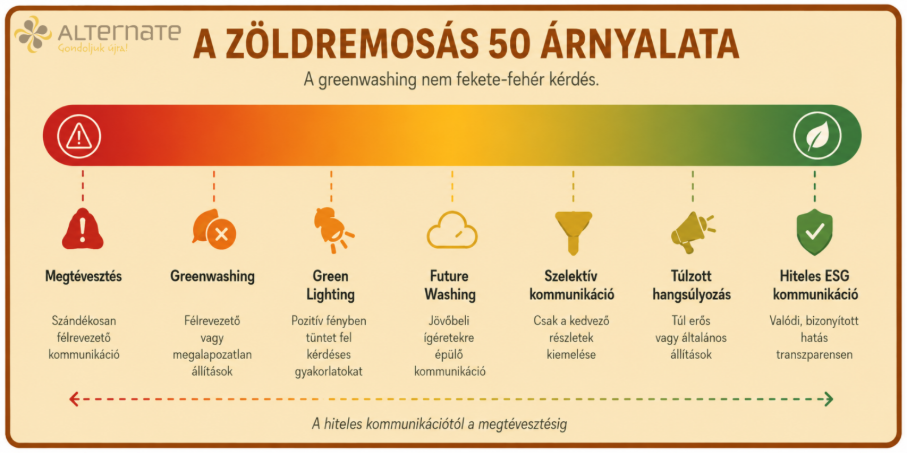
Greenwashing is closely linked to ESG communication. At its simplest, it can be defined as making misleading claims about an environmental aspect of a product, service, or organisation. In Hungarian, the term is often translated as “painting something green.” However, the phenomenon is far more complex than this simple definition suggests. One might even say that greenwashing has fifty shades of green.
The most widely accepted definition of greenwashing is:
“Marketing that highlights a positive environmental benefit in a way that is misleading, exaggerated, or false, creating the impression that a product, service, or organisation is more environmentally friendly than it actually is.”
The academic literature, however, distinguishes seven different forms of greenwashing
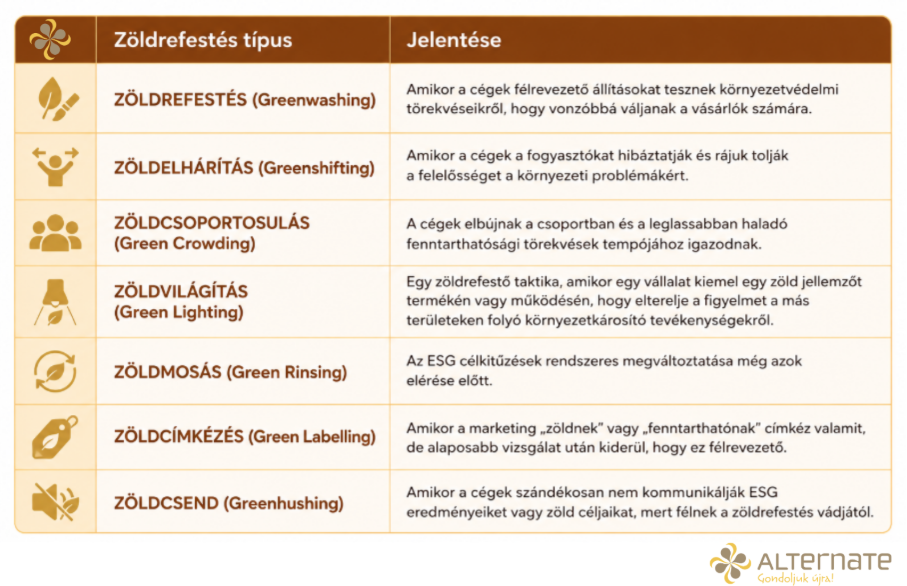
Let us look at some examples:
- when a product or service is disguised as environmentally friendly, while in reality it has minimal or no positive impact on the environment at all (such as the case of reusable cups and biodegradable plastic bags, which also triggered the Hungarian Competition Authority’s [GVH] green marketing guidelines);
- positive environmental impacts are claimed based on tests or experiments that are unrealistic, do not properly model actual product use, or were designed with the intention of manipulation (e.g. the Volkswagen case);
- the environmental impact is presented as more significant than it actually is compared to the company’s overall portfolio or total impact (e.g. communication around the impact of green financing by banks or airlines’ claims regarding sustainable aviation fuels);
- the focus of communication is not on the actual impact and how it is addressed, but rather on diverting attention elsewhere (tree-planting campaigns have often fallen into this category, where companies moved directly to discussing compensation instead of focusing on prevention);
- false or misleading claims are made regarding the composition of a product or its production process (e.g. presenting environmentally friendly packaging as meaning an environmentally friendly product, regardless of the chemical substances contained within it);
- unsupported, unverifiable, or continuously changing future commitments and targets are communicated (e.g. a climate neutrality target without a detailed roadmap);
- legal obligations are presented as voluntary commitments (e.g. an oil company presenting the removal of lead from petrol as an environmentally friendly voluntary achievement);
- misleading packaging or marketing visuals are used (e.g. green packaging or green design elements applied to single-use, disposable packaging).
Researchers had already begun systematically examining the phenomenon of greenwashing well before the widespread adoption of ESG regulations. One of the most widely cited early studies was the 2010 analysis by TerraChoice, which examined consumer goods and household products in the United States. The study introduced the model of the “Seven Sins of Greenwashing”, which shaped professional thinking about the topic for many years.
The model identified the following typical forms of misleading environmental communication:
- hidden trade-off (highlighting a minor positive environmental attribute in order to conceal more significant negative impacts);
- lack of proof (unsupported claims);
- vague or ambiguous wording;
- promoting claims that are irrelevant, even though they may be technically true;
- emphasising the “lesser evil” within an inherently problematic industry;
- factually false claims;
- the use of false or misleading environmental labels.
Although the academic literature has evolved significantly since then and new concepts have emerged (such as greenhushing, greenshifting, and future washing), it is noteworthy that a significant proportion of today’s known greenwashing cases can still be traced back to one of the patterns identified by TerraChoice more than 15 years ago.
Regulation of greenwashing
Although greenwashing has a strong subjective element, meaning that different people may assess the same advertisement, packaging communication, or sustainability report differently, it also has a regulated dimension. Certain forms of greenwashing may qualify as unlawful practices. Under consumer protection legislation, unfair commercial practices are prohibited because they distort consumer behaviour. A commercial practice is also considered unfair if it is listed in the so-called “blacklist” annex of the Consumer Protection Act.
Beyond its impact on consumers, greenwashing may also be regarded as an unfair practice towards competitors. The Hungarian Competition Authority (GVH) expects companies to substantiate the truthfulness of their claims and to enable consumers to verify the accuracy of those claims themselves. These requirements are set out in Act LVII of 2008 on the Prohibition of Unfair Market Practices and Restriction of Competition, as well as Act XLVII of 2008 on the Prohibition of Unfair Commercial Practices against Consumers.
There are also initiatives aimed at combating greenwashing. One such initiative is the Green Marketing Guide developed by the GVH, while the Hungarian Advertising Self-Regulatory Board’s Hungarian Advertising Code of Ethics is another relevant framework. The GVH’s green marketing checklist provides useful guidance for all types of environmental communication.
The Green Claims Directive proposed in 2023 was originally intended to establish a unified and strict EU framework for the substantiation and verification of environmental claims, complementing the SFDR, CSRD, and the EU Taxonomy Regulation. However, the legislative process took a significant turn in 2025: the European Commission announced its intention to withdraw the proposal, making the adoption of the directive currently uncertain.
Despite this, the EU’s regulatory framework against greenwashing continues to strengthen. The Unfair Commercial Practices Directive (UCPD), which prohibits environmental claims that mislead consumers, is already applicable. In addition, the Empowering Consumers for the Green Transition Directive (EmpCo), adopted in 2024, specifically aims to reduce greenwashing, improve the credibility of sustainability labels and environmental claims, and support consumers in making informed decisions.
Member States must transpose the provisions of the EmpCo Directive into their national legislation by March 2026, and the rules will become applicable from September 2026.
Sustainable finance and greenwashing
From the perspective of sustainable finance, two significant types of greenwashing are often highlighted:
Greenhushing, where corporate sustainability goals and actions are deliberately not communicated. The motivation may be to avoid accusations of greenwashing, or it may represent intentional silence and reduced transparency. Some argue that this is highly problematic because organisations tend to focus on and improve what they openly discuss; if they stop communicating about these issues, they may eventually stop taking action on them as well.
Future washing occurs when future-oriented environmental claims are published without proven plans, resources, or capabilities to deliver on those commitments. This may result in a loss of stakeholder trust, while also creating potential litigation risks and regulatory risks — the coming years will show the extent of these consequences.
A fundamental prerequisite of sustainable finance is that investors and analysts are able to make assessments suitable for decision-making based on reliable information and data. To support this, companies disclose sustainability and ESG information, provide data, and engage in green public relations and marketing activities. In other words, communicating sustainability efforts, achievements, and future plans is both a strategic necessity and/or a legal obligation.
For companies, the disclosure of sustainability information is increasingly becoming a business expectation and, in many cases, a regulatory requirement. The objective should be to present the actual situation, plans, capabilities, and results in order to support responsible decision-making by stakeholders.
In reality, however, companies inevitably introduce certain biases into their communication. Every organisation seeks to present itself, its efforts, and its achievements in a more positive light in order to maintain a favourable reputation. Companies may also be biased when assessing their own efforts and shortcomings, or they may simply lack visibility into certain deficiencies, delays, or operational failures.
This is a natural phenomenon — which is why independent assessors, watchdog organisations, mystery shopping, audits, due diligence processes, and certifications play such an important role. These mechanisms allow independent parties to review, verify, and validate corporate disclosures.
The emergence of sustainability-related frameworks such as the EU Taxonomy, mandatory sustainability reporting requirements, ESG reports, and ESG ratings has completely reshaped the market: the volume of assets invested based on sustainability or green criteria has increased, and so has the number of related abuses. There is almost a greenwashing-related news story every day… (Some examples are discussed in more detail here.)
Greenwashing can create several types of risks for sustainable finance.
Misguided sustainable finance decision-making due to misleading data and information: Some of the greenwashing examples described above primarily pose a risk of misleading consumers. However, many of them can also distort sustainable finance decisions. For example, ESG ratings or scores may be developed based on publicly available information and then used by investors in their decision-making — only for it to later emerge that the underlying claims were insufficiently substantiated, or that the data is revised on an annual basis.
ESG ratings cannot always adapt to such changes quickly enough. This is why it is increasingly important that assessments rely on validated or certified data sources. Banks and rating agencies, for example, may not be able, in the short term, to ensure that data is collected, compared across companies, or verified through audits or other validation methods in a timely manner.
More sophisticated and complex methodologies are therefore becoming increasingly necessary. These methodologies examine appropriate evidence and historical data series, identify inconsistencies, and consider industry-specific performance indicators. The demand for such robust ratings and assessments is expected to grow significantly.
The real test of greenwashing
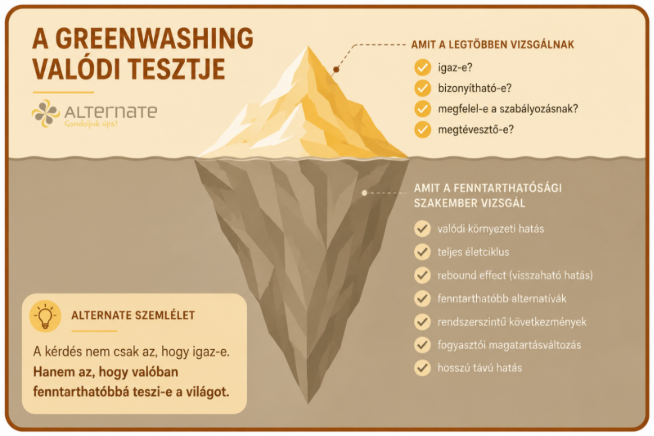
Fertetics Mandy, Managing Director of Alternate, has recently delivered training sessions and interactive presentations on greenwashing to numerous corporate and ESG professionals. She found it particularly interesting to observe how rigorous experts can be when evaluating individual advertisements or corporate messages.
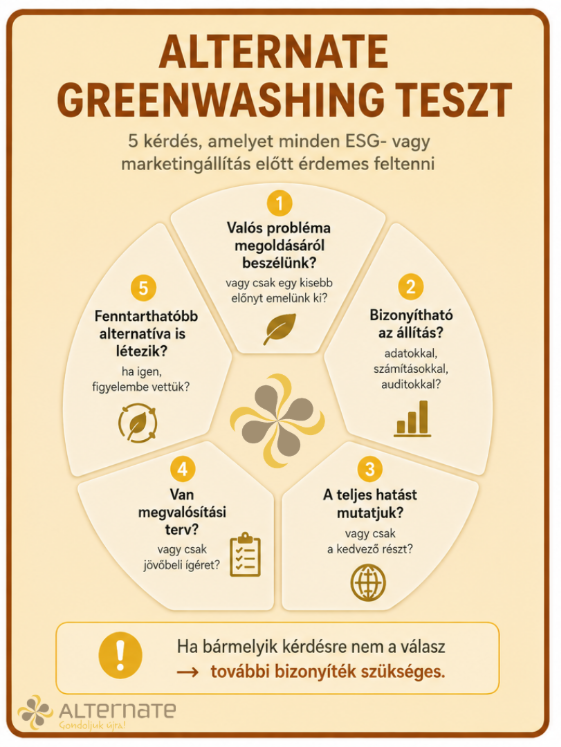
“A holistic, systems-based perspective becomes much stronger among participants in these situations, and they start asking: is there a more sustainable solution to this consumer or lifestyle challenge? If yes, then the product or solution is no longer truly green (or at least not as green as presented). Is there a rebound effect — meaning that a ‘small green product advantage’ leads to an unjustifiably large increase in consumption, ultimately turning the overall environmental balance negative?
Of course, these are already complex interpretations and evaluations — but they are essential. Marketing and communication professionals currently tend to approach their work primarily from a legal compliance perspective (how far can we go?). However, the time will come when ethical and philosophical questions will also need to be brought to the table.
These discussions may initially feel uncomfortable and may appear ‘anti-business’ because they challenge fundamental paradigms and established marketing communication practices. However, if we allow ourselves to engage in these debates and confront different perspectives, we can create truly sustainable products, consumer behaviours, and lifestyle changes.
Marketing shapes these developments; it does not merely serve existing ones.”